

Using the wrong fire extinguisher can make a fire worse, so every fire warden should know the main types and the fire classes they tackle. This simple guide explains the five common extinguishers used in Irish workplaces and when each is appropriate.
Remember: only ever tackle a small fire if it is safe to do so, and never at the expense of your own escape.
Key takeaways
Short on time? Here are the essentials at a glance, with the detail in the sections that follow:
- Fire classes in Ireland
- The five common extinguishers
- The PASS technique
- Safety first - Extinguishers are for small, early-stage fires only.
- The five extinguisher types and when to use them - Using the wrong extinguisher can make a fire far worse, so knowing the colour codes is genuinely useful safety knowledge.
- Fire classes explained - Extinguishers are matched to fire "classes" based on what is burning.
- The PASS technique - If it is safe to tackle a small fire, the PASS method keeps it simple: Pull the pin, Aim at the base of the flames, Squeeze the ha...
- Knowledge versus hands-on practice - It is important to be honest about limits.
Fire classes in Ireland
- Class A - solids such as wood, paper and textiles
- Class B - flammable liquids such as petrol and solvents
- Class C - flammable gases
- Class D - flammable metals
- Class F - cooking oils and fats
- Plus electrical fires, which need a non-conductive extinguisher
The five common extinguishers
| Extinguisher | Best for | Avoid on |
|---|---|---|
| Water | Class A solids | Electrical, liquids, fats |
| Foam | Class A and B | Electrical, fats |
| CO2 | Electrical and Class B | Class A, fats |
| Dry powder | A, B, C and electrical | Confined spaces (visibility) |
| Wet chemical | Class F cooking oils | Electrical (unless rated) |
The PASS technique
- Pull the safety pin
- Aim at the base of the fire
- Squeeze the handle
- Sweep side to side
Safety first
Extinguishers are for small, early-stage fires only. If a fire is spreading, raise the alarm, evacuate and let the fire service deal with it. Practical extinguisher practice is best arranged by your employer alongside online training.
The five extinguisher types and when to use them
Using the wrong extinguisher can make a fire far worse, so knowing the colour codes is genuinely useful safety knowledge. In Ireland and across the EU, the body of the extinguisher is red, with a coloured band or label showing the type.
- Water (red label) - for ordinary combustibles like wood, paper and textiles. Never on electrics or cooking oil
- Foam (cream label) - for combustibles and flammable liquids such as petrol and paint
- CO2 (black label) - for electrical equipment and flammable liquids; leaves no residue
- Dry powder (blue label) - a versatile multi-purpose option, but messy and not ideal indoors
- Wet chemical (yellow label) - designed for cooking-oil and deep-fat fryer fires in kitchens
Fire classes explained
Extinguishers are matched to fire "classes" based on what is burning. Knowing the class helps you reach for the right one without hesitation.
- Class A - solids such as wood, paper and fabric
- Class B - flammable liquids such as petrol and solvents
- Class C - flammable gases
- Class D - metals
- Class F - cooking oils and fats
- Electrical fires - a separate category where CO2 is the safe choice
The PASS technique
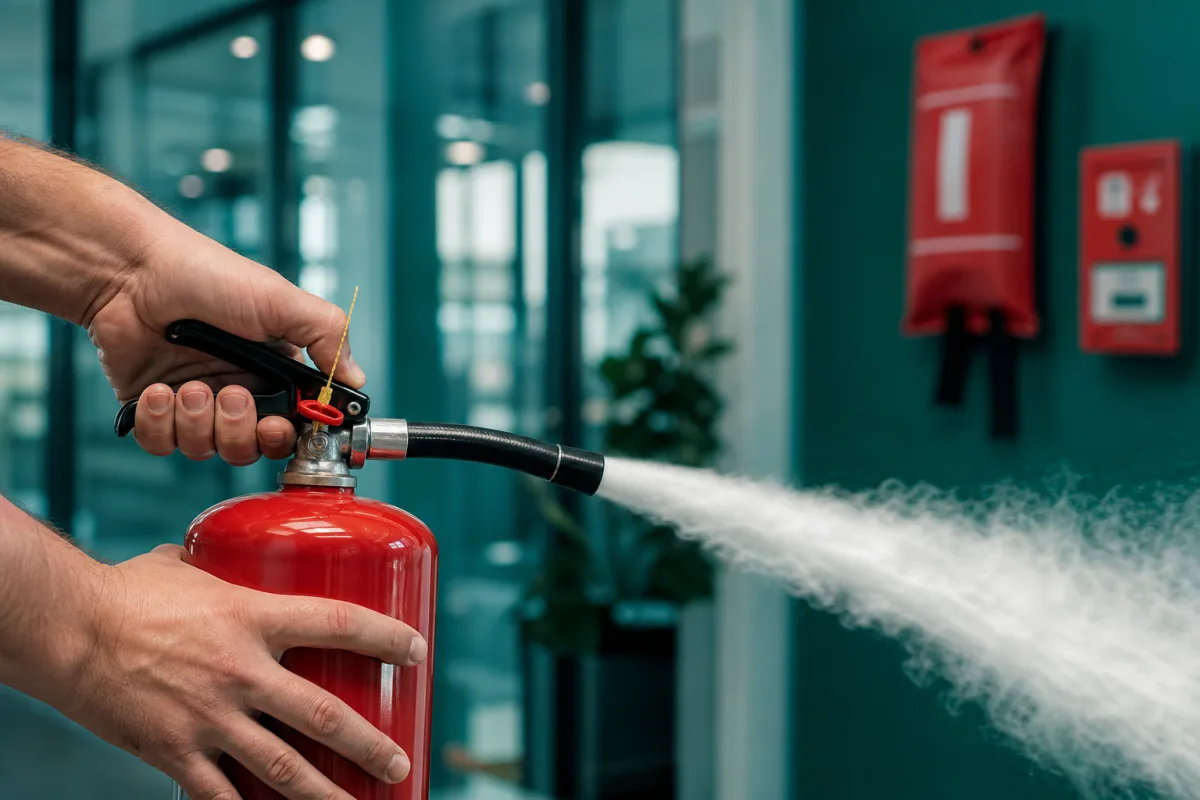
If it is safe to tackle a small fire, the PASS method keeps it simple: Pull the pin, Aim at the base of the flames, Squeeze the handle and Sweep from side to side. Always keep an exit behind you, never let the fire get between you and the door, and if it does not go out quickly, leave immediately and let the fire service take over.
Knowledge versus hands-on practice
It is important to be honest about limits. Learning extinguisher types online builds the awareness a fire warden needs to make the right call under pressure. It does not, by itself, give the muscle memory of discharging a live extinguisher. Where a workplace wants that hands-on competence, the employer can arrange a short practical session to complement the online knowledge.
Important: This online course supports awareness and understanding of workplace fire safety. Employers in Ireland may still need to provide workplace-specific training, supervision, fire drills and a fire risk assessment for their premises. Staff should always follow their employer's procedures, evacuation plans and internal fire safety rules.
Ready to get certified? You can complete the same-day Fire Warden Certificate entirely online and download your certificate as soon as you pass.
Frequently Asked Questions
What extinguisher should never be used on cooking oil?
Never use water on a cooking-oil or deep-fat fire - it can cause a violent flare-up. Wet chemical extinguishers are designed for this type of fire and are standard in commercial kitchens.
Can one extinguisher cover most situations?
Dry powder is the most versatile, but it is messy and reduces visibility indoors. Most workplaces use a mix - typically water or foam plus CO2 - chosen by their fire risk assessment.
Do fire wardens need to use extinguishers?
Only on a small fire, only if it is safe, and only if trained. A warden's priority is always raising the alarm and evacuating, not firefighting.
What fire extinguisher is used for electrical fires?
CO2 is the usual choice for electrical fires because it does not conduct electricity. Dry powder can also be used. Never use water or foam on a live electrical fire.
Which extinguisher is for cooking oil fires?
A wet chemical extinguisher is designed for Class F cooking oil and fat fires, common in kitchens.
Should I always try to put out a fire?
No. Only tackle a small, contained fire if it is safe. If in any doubt, raise the alarm, evacuate and call the fire service.
Related Fire Warden guides
- Fire Marshal duties explained
- Fire Safety Awareness Training Ireland
- Workplace Fire Safety Training Ireland
Start your Fire Warden Course online today and get a certificate that is valid for 3 years across Ireland.